Horses in the U.S. Military: Honoring Service & Sacrifice This Memorial Day
Every Memorial Day, Americans pause to remember the men and women who gave their lives in service to our country.
Flags are placed. Names are spoken. Families gather. Silence means something.
And in the background of many of our nation’s most powerful military traditions stands a partner that helped carry America through generations of conflict:
The horse.
Long before engines, helicopters, and armored vehicles, horses carried soldiers into battle, transported supplies, pulled artillery, evacuated the wounded, and helped build the United States itself. Their contribution to military history is inseparable from the people who served beside them.
This Memorial Day, we remember both – and offer our deepest gratitude to every service member and military family who has sacrificed for this country.
Before Tanks and Trucks, There Were Horses
For most of human history, military strength moved at the speed of a horse.
In the United States, mounted military units played essential roles from the Revolutionary War through the Civil War and into the early 20th century. Cavalry units covered impossible distances, delivered messages, scouted enemy movement, and often arrived where no wagon or machine could. Horses also pulled artillery and supply trains that kept entire armies moving.
Military horses weren’t equipment.
They were partners.
Soldiers depended on them for survival.
History is full of stories of cavalry mounts carrying injured riders home, standing calmly under fire, or continuing through impossible conditions because someone needed them to. Their loyalty became part of military culture itself.
The Legacy That Still Lives Today
America’s military may no longer rely on cavalry in combat, but horses still hold a place of honor.
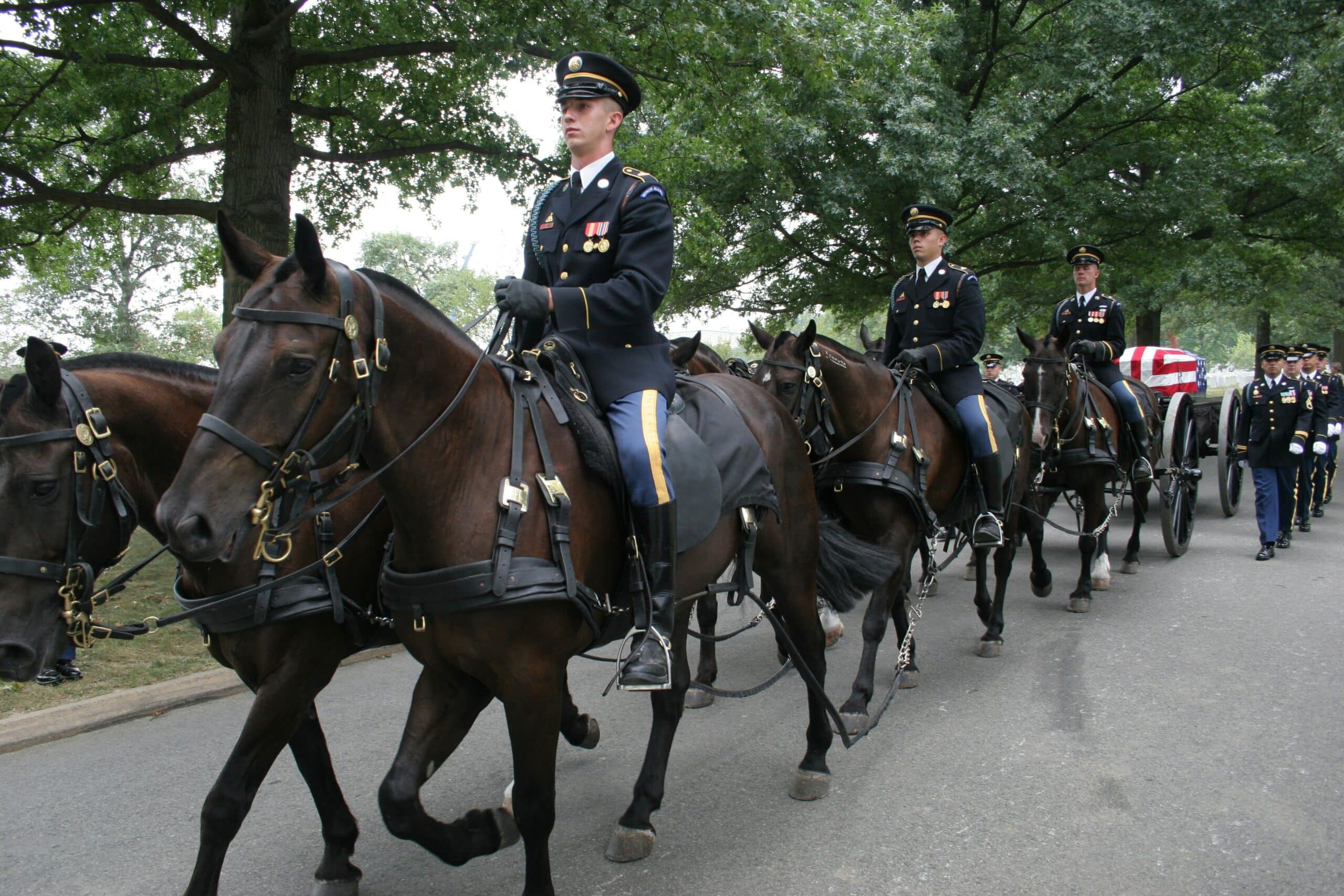
One of the most visible examples is the U.S. Army’s ceremonial caisson tradition at Arlington. Horse-drawn caissons carry fallen service members to their final resting place in one of the country’s most solemn military honors. The tradition traces back to horse-drawn artillery units that historically carried supplies into battle and often returned carrying the fallen.
The program is carried out by the Army’s Caisson Detachment of the Old Guard and remains one of the most recognizable military ceremonies in the nation. After extensive modernization and renewed emphasis on horse welfare, horse-drawn caisson services resumed in 2025.
Another unforgettable military image is the riderless horse – boots reversed in the stirrups – walking behind a fallen leader’s procession.
That image symbolizes a warrior’s final ride.
One of the most famous was Black Jack, who participated in more than 1,000 full-honor funerals and became an enduring symbol of service and remembrance.
Memorial Day Means More Than a Long Weekend
Memorial Day is not Veterans Day.
Veterans Day honors all who served.
Memorial Day specifically honors those who never came home.
It remembers the empty chairs at family dinners.
The birthdays missed.
The children raised with stories instead of memories.
The generations shaped by sacrifice.
For many military families, Memorial Day is deeply personal.
And for horse people, there is something especially moving about the quiet dignity of a horse in ceremony – the lowered head, the steady pace, the understanding that some moments deserve reverence.
A Thank You From the Equine Community
At My Equine World, we spend our days celebrating horses and the people who love them.
But today, we pause for something bigger.
To every service member who gave everything –
Thank you.
To every veteran carrying memories no one else can fully understand –
Thank you.
To every military spouse, parent, child, and family member who served in their own way –
Thank you.
And to the horses who carried history forward – one hoofbeat at a time – we remember you too.
This Memorial Day, may we honor sacrifice not only with words, but by living lives worthy of the freedom we’ve been given.
We remember. We honor. We are grateful.
If someone in your family served alongside horses – or if you have military horse stories, photos, or memories – we’d love to hear them and help preserve those stories for future generations.